
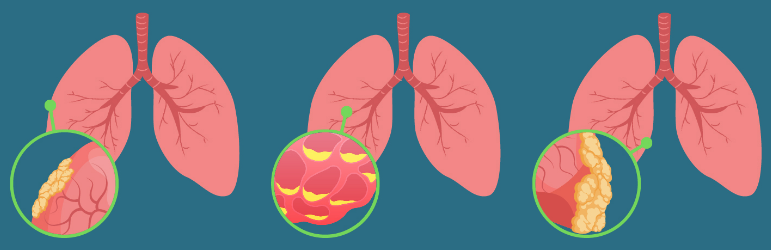
Lung cancer, usually does not cause obvious symptoms in its early stages. As the disease progresses, however, some symptoms may appear. These symptoms are:
1. Chronic Cough
- A persistent cough that gets progressively worse.
- Bloody sputum may sometimes be seen (hemoptysis).
2. Shortness of Breath
- Difficulty breathing even with light exertion.
- Wheezing may be heard.
3. Chest Pain
- Chest pain felt especially when breathing deeply, coughing or laughing.
4. Hoarseness
- Unexplained voice changes that last a long time.
5. Loss of Appetite and Weight Loss
- Unexplained weight loss and loss of appetite.
6. Fatigue and Weakness
- Loss of energy to the point that even daily activities become difficult.
7. Recurrent Infections
- Frequently recurring lung infections such as bronchitis or pneumonia.
8. Swelling of the Fingers (Clubbing)
- Thickening of the fingertips and rounding of the nails.
9. Swelling of the Neck or Face
- Swelling caused by obstruction of blood flow by a tumor in the lung.
10. Bone Pain
- Pain especially in areas such as the spine, ribs or hips.
Lung Cancer Stages and Details
Lung cancer is classified into four main stages according to how far the disease has spread. Each stage describes the size of the cancer and whether it has spread to the lymph nodes and other organs. Lung cancer is generally examined under two main types:
- Small Cell Lung Cancer (SCLC)
- Non-Small Cell Lung Cancer (NSCLC)
Staging is similar for both types, but treatment approaches may differ.
Stage 1 (Stage I)
The cancer is at an early stage and is found only in the lung.
- Features:
- The tumor is small (usually smaller than 4 cm).
- There is no spread to the lymph nodes.
- Symptoms:
- There may be no symptoms, or only mild ones (a slight cough or shortness of breath).
- Treatment:
- Surgical removal of the tumor (lobectomy, segmentectomy).
- Radiotherapy or chemotherapy if necessary.
Stage 2 (Stage II)
The cancer is larger within the lung and may have begun to spread to the lymph nodes.
- Features:
- The tumor has grown (4-7 cm).
- The cancer may have spread to nearby lymph nodes or around the bronchus.
- Symptoms:
- A more noticeable cough, chest pain and mild fatigue.
- Treatment:
- Surgery (removal of the tumor and the affected lymph nodes).
- Chemotherapy or radiotherapy after surgery.
Stage 3 (Stage III)
The cancer has spread over a wider area and is considered locally advanced.
- Features:
- The tumor is large (it may be more than 7 cm).
- The cancer has spread to areas outside the lung (for example the chest wall or mediastinum) or to distant lymph nodes.
- Substages:
- Stage IIIA: The tumor has spread to lymph nodes on the same side of the lung.
- Stage IIIB: The tumor has spread to lymph nodes on the opposite side or to other structures.
- Symptoms:
- Severe shortness of breath, chest pain, bloody sputum and weakness.
- Treatment:
- Chemotherapy and radiotherapy are generally preferred.
- Surgery can sometimes be performed.
Stage 4 (Stage IV)
This is the most advanced stage, in which the cancer has spread to distant organs (metastasis).
- Features:
- The tumor has metastasized to other organs (liver, bones, brain, adrenal glands).
- The lymph nodes are also extensively involved.
- The spread often involves both lungs.
- Symptoms:
- Severe pain (in the bones, headache), severe fatigue, rapid weight loss, bloody sputum and shortness of breath.
- Treatment:
- Surgery: Usually not possible.
- Targeted Therapy and Immunotherapy: Immunotherapy and molecular targeted therapy, which are part of standard treatment for suitable patients.
- Chemotherapy and Radiotherapy: Used to relieve symptoms and prolong life.
Staging Tools and Tests
- CT (Computed Tomography) and MRI: Show the size and spread of the tumor.
- PET-CT: Identifies metastases.
- Bronchoscopy: Direct visualization of the tumor and biopsy.
- Blood Tests: Assess general health.
The Importance of Treatment
If lung cancer is diagnosed at an early stage, the chance of treatment success is much higher. In advanced stages such as Stage IV, the goal of treatment is generally to keep symptoms under control and improve quality of life.
For more detailed information or a personal evaluation, we recommend consulting a chest disease specialist or thoracic surgeon.
| Stage | Features | Symptoms | Treatment |
|---|---|---|---|
| Stage I | – Small tumor (< 4 cm). – No spread to the lymph nodes. | – Mild cough. – There may be no symptoms. | – Surgery (lobectomy, segmentectomy). – Radiotherapy or chemotherapy if necessary. |
| Stage II | – Medium-sized tumor (4-7 cm). – May have spread to nearby lymph nodes. | – More noticeable cough. – Chest pain. | – Surgery and removal of lymph nodes. – Chemotherapy/radiotherapy after surgery. |
| Stage III | – Large tumor (> 7 cm). – Lymph nodes and surrounding tissues are involved. – Has not spread to distant organs. | – Severe shortness of breath. – Bloody sputum, weakness. | – Chemotherapy and radiotherapy. – Sometimes surgery. |
| Stage IV | – The cancer has metastasized to distant organs. – Both lungs may be affected. | – Severe pain (bone, head). – Rapid weight loss, shortness of breath. | – Immunotherapy or targeted therapy. – Chemotherapy and radiotherapy. |